Showing posts with label Bread. Show all posts

Monday, February 6, 2012

Gluten-free Mustazzoli


For those of you who have read my previous entry on mustazzoli, you will know that this honey bread/cookie is popular amongst Southern Italians. (To read my previous recipe on traditional mustazzoli click here.) These cookies are naturally dairy-free. However, for some time now, I have been thinking about developing a gluten-free recipe. I have tested out this particular recipe and it works great!

This recipe uses buckwheat products to add a characteristic flavour. You will need to begin with 1 cup of buckwheat honey. This type of honey is quite commonly found in most large supermarkets and specialty food stores.


As you can see, the honey has a deep amber colour.

To the honey, add two large eggs.


Whisk to combine the two liquid ingredients together.


Now add 4 tablespoons of blanched almond flour.


Once added, you may give the mixture a quick stir.


You will now require one cup of buckwheat flour. 


Spoon and whisk the flour, into the liquid mixture, 1-2 tablespoons at a time. Once all of the buckwheat flour has been incorporated, the mixture will look like the picture below.


So far so good. Now, add 2 teaspoons of baking powder and whisk it into the mixture.


For the next part of the recipe, you will require roasted white rice flour. This type of rice flour has a texture more similar to wheat flour compared to regular white rice flour. In the Greater Toronto Area, roasted white rice flour can be found very easily at supermarkets catering to the South Indian and the Sri Lankan market.


Slowly, adding 1-2 tablespoons at a time, stir in enough roasted white rice flour to form a stiff dough. You will know that the dough is stiff enough when you can stick a whisk or spoon in it and it will be able to stand vertically.


Transfer large dollops of the dough onto a greased cookie sheet (greased with olive oil). With oiled hands, form the dough into small logs.


Bake the logs in a preheated 350°F oven for approximately 30 minutes or until golden brown.


Let the logs are cool to the point where you can handle them.  While still warm, cut the logs into thin slices.


Once cooled, these gluten-free mustazzoli will be ready to enjoy.


Tuesday, July 19, 2011

The Best Thing since Sliced Bread

I think Islanders, no matter where they're from, have got it right. People from islands tend to do things just a little bit differently from us mainlanders.

One of the everyday things I saw, on the island of São Miguel, Azores, was a service for bread delivery. Those of you who know me well, will know that bread is one of my favourite foods. However, having the bread come to your door, brings it to another level altogether!


On São Miguel, bread is a very important part of one's diet. It is eaten with almost every meal. That being said, it is not unusual to see bread vans with signs reading "Transport and Sale of Bread" in any given neighbourhood.

These companies also don't expect cash on delivery. The vendors will simply leave a package of bread for you on your front door.

Now, rather than the paper, wouldn't you like to see this first thing in the morning?

What a great idea; a bakery that comes to you! (It's the small things that make me happy.)

Sunday, July 17, 2011

Furnas

This is a familiar sign that is seen in and around the town of Furnas in São Miguel. Furnas is somewhat centrally located on the island and is home to many "calderas" or hot springs. The hot springs can be either sulfur or iron based.

You know you are approaching the town when you start to see misty clouds, steam coming out of the ground and when you sniff the somewhat familiar smell of slightly rotten eggs in the air (from the sulfur).

Viewing the calderas, you can see why they are quite the phenomenon.  Since São Miguel is a volcanic island, there are areas where water is heated by the Earth's core.

Since the pictures don't really do it much justice, please enjoy this video clip.

You're probably asking, "Why is this post on a food blog?" Well, to answer your question, the calderas are also used to cook on. Think of the word "caldera" having the same root as the word "cauldron". Pots of meat and vegetable stews are placed either in the hot boiling water or in the surrounding ground/mud. The high temperatures of the environment make it possible for the ground to be used as natural elements and ovens. Talk about living green!


Also, exclusive to the area, is a bread known as "bolos lêvedos". The name literally translates to "leavened cakes", but the product is really known as a bread.


The bread is made with very simple ingredients including: flour, eggs, sugar, milk, butter, salt and yeast. It is cooked on a flat surface, similar to the process used when making pancakes.


The result is a bread that is somewhere in between a bread and a cake. It has many nooks and crannies similar to English muffins, with a slightly sweet flavour.

This bread is fantastic with any meal or as snack. I'm currently reviewing some recipes to see if I can make this delight at home.

Saturday, July 16, 2011

São Moo-guel

The Azores is a grouping of nine islands located, pretty much, in the middle of the Atlantic Ocean. Together, they are an autonomous region of Portugal and make the western-most part of Europe.

I was lucky enough to visit São Miguel, the largest of the islands, nicknamed "The Green Island", because of its steady, moderate climate and green landscape. I use of the word "large" only in comparison to the other islands. São Miguel, at its furthest points, is approximately 65 km long and 14 km wide. On some points of the island, you can actually stand and see both North and South sides at the same time!

Also an interesting fact: all mammals, with the exception of bats, were introduced to the island by humans. One of the animals you cannot go without seeing everywhere are black and white jersey cows. With a human population of approximately 240,000, I think I actually saw more cows than people!


These specific type of cows were brought to the island because of their ability to cope with/live in the climate and for their milk production. Dairy production is one of the main industries of the island.

I personally think the reason the Islanders brought these particular cows to São Miguel was because the Azoreans like the look of "black and white" against the backdrop of their land.


Do you think I'm joking? If so, here are a few random pictures that I think prove my theory.


I think that gives the expression "Holy Cow" a whole new meaning!

In any case, it is not unusual to see people milking their cows on their land.

As you can see, pumping can occur quite casually as the animal feeds comfortably off a trough.

The rich cow's milk is used to produce butter and many varieties of cheese.

One of the more memorable cheeses, for me, was "queijo fresco" or fresh cheese. The Azoroean version was a little different from the Spanish and Italian versions, of fresh cheese, I have tried. Their version is a bit saltier and is normally eaten with a red pepper sauce called, "molho de pimenta".


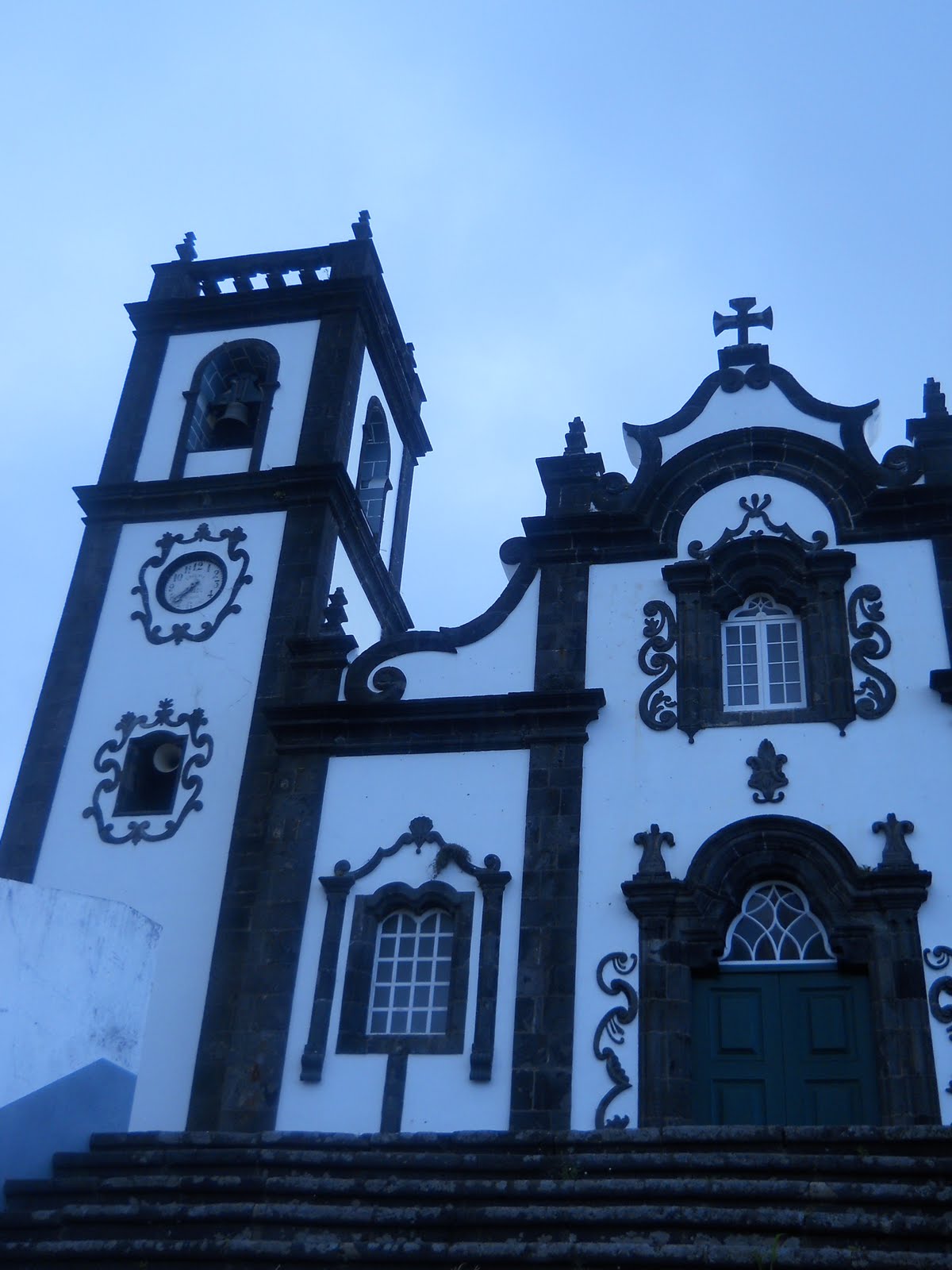
The milk itself is also used on São Miguel, like here at the "Festa do Espírito Santo" or Feast of the Holy Spirit. The feast, or more correctly feasts, take place over a number of weeks with activities including processions, crowns of the Holy Spirit and, of course, food. (There will be more to come regarding the Festa do Espírito Santo.)

On this particular day, milk was being distributed after a Catholic mass.

The milk was served alongside a sweetbread called "massa" or "massa sovada". This type of bread is also served during other holidays, including Christmas and Easter.


The bread is slightly dense, with a light crust and an eggy-sweet flavour.

What a pair!

Thursday, April 7, 2011

La Tortilleria

I love Toronto for the fact that it can satisfy any culinary need. Yesterday, my craving-of-the-day was for tortillas and I don't mean the disc-like things you can pick up from the supermarket. Tortillas are a Latin American flat bread, normally made from a corn flour mixture called masa. All-corn versions are available, which are naturally gluten-free.


I visited a place in Kensington market called La Tortilleria (198 Augusta Avenue). There are a few locations of this shop within the Greater Toronto Area. In Spanish, the shop's name means tortilla bakery or tortilla shop. The shop sells old world style tortillas by weight. The stack below (approximately 1 kg) cost me $3.00 CAD. They were actually warm when I picked them up!


The bread keeps well, for approximately 2 to 3 weeks, in the refrigerator. Alternatively, they can be frozen. (They don't last that long at my place!)


As you can see, the bread is paper thin and is perfectly made for holding other ingredients. They have a rather simple corn flavour, which lends itself well for breakfast, lunch or dinner.


I decided to go simple and savory for dinner. I made a wrap with some frittata, caramelized onions and homemade mayonnaise.


For my recipe for frittata, click here.
For my recipe for homemade mayonnaise, click here.


The tortillas can also be baked, pan-fried or deep-fried. They are a definite must-try that will leave you feeling like you are in Mexico!

Saturday, March 12, 2011

Bread-less Breading

A small disadvantage of gluten-free cooking is the inability to enjoy breaded foods. Even though the amount of bread used to coat/cover foods is minimal, it can be a nightmare for some to digest these ingredients. In any case, breaded foods are so good that it would be a total shame for people not to enjoy them.


For this reason, I have come up with an extremely flavourful, bread-free breading which, by the way, tastes even better than using breadcrumbs alone!


It's really quite simple. You will require the following ingredients for the breading:
- 3/4 cup crushed, blanched almond meal
- 3/4 cup dahl flour (yellow lentil flour)
- a dash of paprika
- a dash of chili powder
- freshly ground black pepper to taste
- salt to taste (I used approximately 1 teaspoon)
- 1 teaspoon of sugar


Note: You can find dahl flour quite easily at any East Indian or West Indian grocery store.


Simply mix the above ingredients together and use it wherever you require breading.


I decided to use the mixture to make gluten-free breaded chicken.


I began with some chicken cutlets.


To bind the breading to the cutlets, I made an egg wash by combining two large eggs with 2-3 tablespoons of water.


Place the chicken pieces into the egg wash.


Then proceed to cover them with the breading.

Note: You can also bread the chicken "Shake 'n Bake" style, by placing the breading in a bag and giving the egged chicken pieces a shake.

Place the breaded chicken pieces on a greased baking sheet and bake them until the chicken is fully cooked (to an internal temperature of 182°F).

I swear this chicken is tastes better than when using actual breadcrumbs!