Showing posts with label Sugar and Spices. Show all posts

Tuesday, December 20, 2011

Christmas Craft

In many Catholic traditions, Epiphany (January 6th), symbolizes the last day for Christmas celebrations. Epiphany Eve (January 5th), in the Italian culture, "La Befana" goes out to visit the children of Italy. In this folklore, the Befana is a witch-like lady who fills the socks of good boys and girls with candy and gifts (usually chocolate, nuts and oranges). It's a cute little tradition that is very similar to the gift giving of the more familiar Santa Claus.

Given that the Christmas celebrations are still being held in some cultures, there is rather simple and crafty idea that you can do during this time. It has turned out to be a holiday tradition in my home.


The sight and smell of certain foods can conjure up memories of times past. For me, there are particular smells that remind me of the winter holiday season.

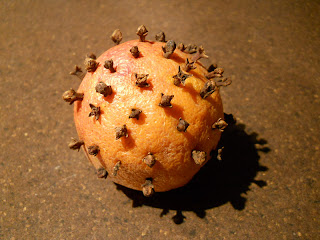
Begin with an ordinary orange.


You will also require a handful of cloves. Pierce the orange with the cloves all the way around the surface of the fruit. (You can also get craftier by creating patterns around the orange.)

The orange and cloves together will create a natural air freshener which will leave your home smelling spicy and warm.

Also, don't worry about the orange going bad. The cloves will actually petrify the fruit and turn it into a hard ball.

Tuesday, March 15, 2011

All Dressed Up and Ready to Go

Stepping away from traditional dressings can be difficult for some. Take these steamed green beans for instance. I could easily make a vinaigrette and have the side of boring with my meal. Today I decided to add an exciting ninja kick instead. 

Enter Shichimi Togarashi. Shichimi Togarashi is a Japanese spice blend meaning "seven flavour chili pepper". It is made with dried peppers, orange peel, black and white sesame seeds, and seaweed. It is available in most Asian grocery stores, catering to the Japanese market, in the Greater Toronto Area.

I decided to mix the magic powder to some sesame oil. Sesame oil is commonly used in Asian cooking to enhance the taste of foods. It has a high nutritional content containing omega fatty acids, vitamins and minerals.

I topped the green beans with the oil-spice mixture and a little bit of sea salt. I also decided to add a few carrot top leaves to the mix. Unknown to most people, carrot greens are edible. They have a very concentrated carrot flavour and can be used like parsley. (Don't throw them away next time.)


Problem solved. Try it next time, when you're looking for a change from the ordinary.

Saturday, February 12, 2011

Arabian Heat

Arabs love their spice and I love them for it. Blending spices with peppers is one of the ways that the Arab world has been able to inject great flavours into their foods. In Tunisia, I have witnessed truck loads of hot peppers being transported here and there, ultimately to be used in culinary preparations.


One of the ways Tunisians and Algerians enjoy spice blends is in a preparation called harissa. Harissa it's basically a hot chilli or pepper sauce created by combining different peppers with spices and olive oil.

Before serving, the mixture is added to even more olive oil and is usually consumed as an appetizer. People in Tunisia swear by their family recipes and often boast that their own concoctions are better than any others. During my visit, our driver even brought his own homemade harissa to a restaurant, as the restaurant's version just wouldn't do.

You won't have to go all the way to North Africa to find this food product. It is available at supermarkets and grocery stores, in the Greater Toronto Area, catering to the Arab market.
(Photo courtesy of A.V. Thank you.)

I have been able to use harissa in other culinary applications including:
- adding some to marinades
- giving a kick to curries
- as an accompaniment to meat, such as lamb, beef or goat
- providing a boost of flavour to salsas and dips

Another type of Arab spice blend is called zaatar. Zaatar is a mixture of herbs, spices and sesame seeds that is used as both spice and a condiment. There are many recipes available, all including different measurements and mixtures of spices and herbs. This is also another combination that people tend to base on their own family recipes.

You also don't need to have an Arab family member in order to enjoy zaatar. You may purchase premixed blends, like this one by Cedar Phoenicia.

You can use the zaatar in many ways, including:
- combining it with olive oil to make a spread
- sprinkling it over fresh yoghurt cheese called labneh (To learn how to make your own yoghurt cheese, click here.)
- using it to create spiced breads
- spicing up bland vegetables
- giving a kick to hummus and other dips


Wednesday, November 24, 2010

Almond Joy

A handful of almonds is a healthy and tasty snack, but did you ever wonder where almonds come from?

Almonds grow on deciduous trees that become fruit-bearing after about five years. Harvest season is usually in the autumn. However, the harvest begins in the end of May-beginning of June in the North African country of Tunisia.


Central Tunisia produces sweet almonds (as opposed to the bitter almond variety) for consumption, as well as for the production of almond oil. The almond oil is exported, mainly to France. It is then used in the cosmetic and perfume industry.


Chanel No. 5 aside, almonds are great to eat!

Tunisians also use them in a type of tea that is aptly called "thé aux amandes".

Picture a Moroccan-style tea that is made with fresh mint leaves, honey and hot water.


Now add a handful of almonds.

This warm drink is perfect for those late afternoons were you feel parched and peckish. It has the perfect combination of soothing elements from the mint, sweetness from the honey, and crunch from the almonds.

Tchin tchin!

Friday, October 29, 2010

Curry in a Hurry

When craving comfort food, my mind often turns to curries. I believe that there is a misconception in thinking that curries are difficult to make. However, I do believe that the difficulty lies on the fact that most people do not have the required spices readily available. Once you build-up your spice rack, with a few simple spices, India will be at your fingertips.

Here is my take on a curry using okra (a.k.a. lady's fingers).

I begin with rinsing/washing some okra.


You may use fresh, frozen or canned okra for this recipe. In this case, I used a canned variety by Phoenicia. I think this product is great, as it doesn't contain any harsh preservatives.


You will also want to keep aside approximately 1 cup chopped carrots. I find that carrots compliment the okra very well, mainly due to their sweetness. As an alternative, you may want to use potatoes or even sweet potatoes.


Now you will begin to create the base for your curry. You will need approximately 1 teaspoon of black mustard seeds.


Place the mustard seeds in a pot with approximately 1 tablespoon of olive oil. Cover the lid and set the temperature to high. You will begin to hear the mustard seeds pop like popcorn. This process ensures that their magnificent flavour is released.


Once you hear the popping stop, remove the pot from the heat and open the lid.


Now place inside some puréed tomatoes.


Note: You can use any type of tomato for this dish (e.g., fresh tomatoes, crushed tomatoes or even tomato paste). If you decide to use alternatives, you will have to adjust the amount of water added.


Here come the spices. In a small bowl, I set aside the following:
- 2 teaspoons turmeric
- 2 teaspoons cumin
- 2 teaspoons coriander
- 2 teaspoons paprika
- 2 teaspoons minced garlic
- chili flakes to taste (this ingredient can be omitted)


Literally dump the spices into the tomato purée. Add salt to taste.


Give it a bit of a whirl, cover and let it sputter away on the stove, for approximately 2-5 minutes.


You have now created a base for your curry.


Mix in the pieces of okra and carrot.


Top off the mixture with a little water, so that you have enough moisture to cook the vegetables well. Cover and simmer until your carrots ready (approximately 20 minutes).


This hearty and spicy dish will leave you wanting more. Enjoy it with bread, roti, or on a bed of basmati rice.


Monday, October 11, 2010

Masala, Marks & Sparks

Masala Chai, or spiced Indian tea, has become quite a novelty beverage. Chai can be found easily in supermarkets, cafés and in tea shops. However, I have noticed that many of these beverages are made with non-traditional ingredients such as syrups, sugars, sweeteners, preservatives and dairy alternatives.

In addition, masala chai does not tend to satisfy the needs of coffee drinkers. For these people, there is another beverage that can be made (with thanks to our Indian friends). This drink is called masala coffee or spiced coffee.

Before I describe the recipe, you will need to understand the basic spices that are used.

Firstly, we have cardamom. These green pods are the seeds of a plant related to ginger. They have a floral, spicy taste and are very aromatic. Cardamom can be used in both sweet and savory dishes.

Note: Do not use black cardamom pods for this recipe. They have an undesirable smoky flavour. 


Next is cinnamon. The spice is commonly used in North American dishes and comes in two forms; whole and powdered. This sweet and heat-creating spice should be used in its powdered form for this recipe.


Lastly, we have cloves. Cloves have a strong flavour element and can be used in its whole or ground form. They have a scent that is reminiscent of the winter holiday season. I would suggest for you to use cloves in their whole form for this recipe.


After spices, I would also suggest the use of a French press coffee maker. This machine is often known as a coffee press or coffee plunger. I love this appliance, because it enables you to control the strength of your coffee by allowing you to adjust the time you leave it to brew. French press coffee makers are rather inexpensive and can be found readily in kitchen stores. However, I do suggest that you purchase one made of glass and not plastic or metal.


Onward to the method. Begin with placing the following ingredients in your coffee press:
- ground coffee
- spices:
     - 2-4 cardamom pods (squeezed or crushed to allow for the inner seeds to be released)
     - a dash of ground cinnamon 
     - 3-5 whole cloves


Other than the three basic spices listed above, additional spices may be added to change the flavour to suit your individual taste. Some suggestions include:
- nutmeg (to provide a soothing effect)
- ginger (for added heat)
- fennel seeds (for a fresh licorice aftertaste)
- saffron (to add a zing)
- black pepper (for a kick)


As you can see below, I opted to add a dash of nutmeg and some freshly cracked black pepper.


Pour hot or boiling water directly into the coffee press and wait for it to brew to the desired strength you prefer.


Press the coffee, so that the coffee grounds and spices are pushed to the bottom and then your masala coffee will be ready to serve!


This type of coffee can be served quite easily with cookies, cakes, biscuits or biscotti. My personal favourite is to serve it with ginger snap biscuits. When you're looking for Ginger Snaps, the best-of-the-best are from Marks & Spencer. Of course, Marks & Spencer no longer exists in Canada. However, I have been able to find these wonderful, sugary and spicy cookies at the following locations:
- Mrs. Bridges British Bakery in Eglinton Square Mall (Eglinton Ave. E. and Victoria Park Ave.)
- Blighty's Tuck Store (Elora, Ontario)


Mmmm. This brew is a spicy delight which is sure to soothe your senses.


Apki Lambi Umar Ke Liye! (Here's to your long life!)

Thursday, September 23, 2010

It's Not a Quince-cidence

Quince are very firm, bright yellow fruit that you have probably seen in your supermarket. They are related to apples and pears and it is even believed that the apple, in the story of Adam and Eve, was actually a quince. (Somehow, referring to a man's "Adam's Quince" doesn't feel right.)


Most quince are extremely hard and have a sour/astringent flavour, not lending well to eating raw.  However, I have found that if they are cut thinly and small, they make a great addition to fruit salad.

Quince are quite frost resistant and will remain fresh and usable in your refrigerator for weeks.

You may find quince in a preserved form, usually in syrup. Through my experience, the fruit in this form is flavourful, but is not very appealing in its consistency or appearance.

The Solution: Easy Quince Preserve
Often, the problem with making preserves is that you have to make a massive amount, which takes a great deal of your time and tests your patience. Follow the directions below to make a delicious jar of homemade quince preserve. (That's right, only one jar!)

- Begin with peeling 3 quince
- Shred the the fruit, using a cheese grater or similar appliance, directly into a small sized pot
- Add one 100 mL container of PC Unsweetened “Just Apples” (By the way, I love this product. It contains no artificial flavours or colors and an organic variety is also available.)
- Add the following ingredients:
       - vanilla sugar* (as much as is required, depending on the sweetness
         of the fruit and your taste)
       - honey (same as previous comment above)
       - water (you may need to add water, throughout the process, if the mixture
         thickens too much for your liking or if the fruit requires more cooking)
       - 3 rounded teaspoons of fruit pectin
       - a dash of ground cinnamon

* If you don't want to use vanilla sugar, use regular white sugar and add a teaspoon of vanilla extract.  I would suggest not using vanilla essence (artificial vanilla flavouring), as nothing beats the real thing!

Simmer the mixture until the fruit is cooked.  Jar and you're done!  The directions above yields approximately one 500 mL jar.


Sidebar:  To make your own vanilla sugar, you basically put some granulated white sugar in a jar with a vanilla bean. You can either insert the bean whole or cut it into multiple pieces and leave it in a cupboard for use whenever you need. The natural oils and scent of the vanilla bean will permeate into the sugar et voilà, you have vanilla sugar. It lasts forever and a day. Note, separate out the bits of bean before using the sugar.


Suggestions for use:
- replace regular sugar in recipes for cakes, pies, etc.
- use it for sweetening coffee, tea or other drinks
- make jars of vanilla sugar for people as a great (and inexpensive) homemade gift